Showing posts with label nonfiction for children. Show all posts

Tuesday, June 13, 2023

Unnatural Narrators in Nonfiction

By Linda Skeers


You’ve gathered your information. Checked your facts. You’re ready to start writing but


stop and wonder, WHO is telling this story? WHO is presenting the information? WHO is my narrator?

​Maybe it’s not a WHO, but a WHAT.

An inanimate object. A thing.

Huh?

Let me explain.

Many wonderful books have been written about Martin Luther King, Jr. How do you introduce him to children in a fresh and unique way? That was the task Eve Bunting gave herself -- and she succeeded with THE CART THAT CARRIED MARTIN.

The focus is on the simple, worn down cart that carried his coffin. Bunting was able to show MLK Jr.’s character by comparing his work ethic and struggles with that of the hard-working cart. By stepping back and creating a bit of distance, the story is still emotional – but not sorrowful.

This was just an ordinary cart – that eventually found a home in the MLK Jr. National Historic Site. “This is the humble cart that, not so long ago, carried greatness.”

Sometimes the perfect object can speak volumes.

That’s exactly what happens in Janet Nolan’s THE FIREHOUSE LIGHT.

Nolan had stumbled upon a fascinating little tidbit – a light bulb in the Livermore-Pleasanton Fire Department has been burning for over 100 years!

And nobody knows how.

Great fact. But is that a STORY?

It became one when she took a giant step back, looked at the bigger picture and wondered about all the events the light bulb would have witnessed through the years.

And THAT became the story!

The book follows the evolution of firefighting from volunteer bucket brigades to sophisticated equipment and new and improved techniques – always being illuminated by that single, amazing light bulb.

How do you handle an intense historical event filled with violence, hatred and prejudice in a picture book?

Sounds impossible.

When Rob Sanders first entertained the idea of writing about the Stonewall riots, he thought so too.

Until he stepped back and focused on the two buildings that joined together to become Bonnie’s Stone Wall restaurant – the centerpiece of the event.

You’ve all heard the saying, “If these walls could talk”? Sanders gave them a voice. And they had a lot to say in STONE WALL – A Building, An Uprising, A Revolution.

By allowing the building to describe the events as they unfolded, it gives the reader an extra bit of space – space to take it in, understand it, but not be completely overwhelmed by it. It’s a safe space to view something so intense and powerful.

Looking for a fresh angle on your subject? Don’t stare at it too closely or you could miss an important element. Step back and look again – what else do you see? Specific objects? A place? What’s lurking in the corners?

By exploring your subject AND everything surrounding it, you might discover a unique and unusual way into your story – one that makes it stand out AND pull readers in.

Linda Skeers teaches how to wrote picture books at the Whispering Woods Retreat. You could be one of her students! 
Wednesday, February 16, 2022

Graphic Nonfiction: Visual Storytelling Techniques for True Tales

By Kirsten Larson 

When writing picture books, we’re told to leave room for the illustrator. Pictures tell half the story. But in graphic novels, the visual story is much more important. A picture is literally worth a thousand words, and the illustrator’s job is daunting.

 What does this mean for authors drafting graphic nonfiction scripts?

 As one editor told me, you, the author, must fill in the blanks regarding what should appear in the illustrations. You must imagine every panel (those rectangular boxes) and write extensive illustration notes, called panel description. This includes describing actions and emotions for each panel and providing links to art references for the setting, characters, etc.

If you’re moving to graphic novels from picture books, providing lengthy illustration notes is the opposite of what we’re told to do. Picturing the story takes a mental switch and requires us to build our visual storytelling muscles. To see the possibilities, I recommend studying graphic nonfiction, focusing on “reading” the visual story.

Graphic novels have a lot in common with movies, even sharing some of the same language. (For a great post on camera “shots” in graphic novels, see this post on Rikvah Lafille’s site.) But unlike movies, graphic novels don’t show every second of the action. Otherwise, the books would run to thousands of pages.

Instead, each panel makes a jump in time, and a lot happens between the panels. It’s up to the reader to fill in blanks. The author and illustrator’s job is to figure out what must be shown and what can be left to the reader’s imagination. In other words, what can be summarized, and what must be shown in real time as a scene.

As Jessica Abel and Matt Madden write in Drawing Words & Writing Pictures, every time you start a new panel, you must make three decisions:

  • When does the new panel take place?
  • Where is it set?
  • What does it focus on?

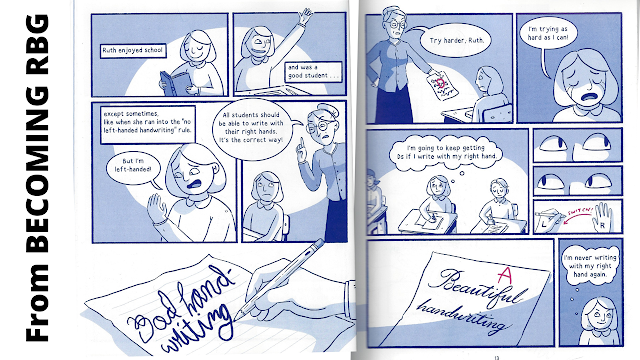
Let’s see how some of these decisions play out in this sample from Becoming RBG by Debbie Levy, illus. by Whitney Gardner.


In this spread, a young Ruth Bader Ginsburg learns to dissent for the first time. (For fun, compare this spread to the same scene from I DISSENT, Levy’s picture book biography on the same subject, which was published first.)

The first two panels are summary, a bit of back story about Ruth.  In the first panel, Ruth is reading, and we’re told she likes school. In the second, we shift to a completely different scene maybe on a different day, where Ruth is at her desk raising her hand. By including just one illustration per scene, we get little snapshots of Ruth’s life, and the story keeps moving forward, covering big chunks of time.

Now let’s look at the two middle panels on page 12. This dialog is a snippet of a scene taking place in real time. The jump in time between panels is very small. What’s changed is the focus of the panels, shifting from Ruth to her teacher. 

As you study graphic nonfiction you may notice dialog handled different ways visually. Sometimes both speakers are included in the same panel, even if only one speaks. Other times, the “camera” shifts completely from one subject to the other. Sometimes the characters are offscreen, and only their dialog appears with the camera focused on something else completely, like a voice over. This provides variety in the illustrations.

Returning to our mentor text, what happens after the dialog? We get a bigger jump in time, perhaps several minutes, as we move from the teacher’s instruction to a close-up view of Ruth’s finished assignment. Between the panels we’ve experienced both a shift in time – from beginning to end of the scene -- and a shift in focus from the teacher to the assignment. Imagine how this would read differently if we watched Ruth complete her assignment step by step. It would slow down the story unnecessarily.

Let’s move to the middle of page 13. This is another scene in real time, but it’s mostly wordless. We are in Ruth’s head, experiencing her thoughts and emotions as she makes the decision to break the rules and write with her left hand. This is pivotal moment in her life. The pacing slows way down, and the jumps in time between the panels is incremental. 

First, we see Ruth’s thought, then, a second later, an extreme close up of her eyes as she ponders. Then another extreme close up of her eyes, as she continues to think. Finally, she chooses to switch hands, and we get a close in view of her hands. Using these moment-to-moment transitions slows the pacing forcing the reader to pay attention.

The more you read and study graphic nonfiction, the more well-versed you’ll become in the conventions of visual storytelling, and the easier writing your own scripts will become.


Give it a Try

Select a spread from a graphic nonfiction book and analyze the visual story. For each panel, consider: When does the panel take place? Where is it set? What’s the subject or focus? Also consider how the “camera” is moving.

 As a bonus, take a scene or two from your own work and consider how it might translate into panels. How would you write the panel description?

 For a list of graphic nonfiction mentor texts, see my Pinterest board.  Happy scripting!


About the Author 

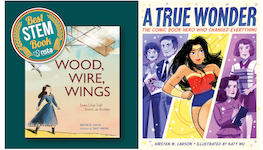
Kirsten W. Larson’s first graphic nonfiction, The Light of Resistance, illustrated by Barbara McClintock, will appear in 2023 from Roaring Brook. Kirsten is the author of the picture books Wood, Wire, Wings: Emma Lilian Todd Invents An Airplane, illustrated by Tracy Subisak (Calkins Creek, 2020), A True Wonder: The Comic Book Hero Who Changed Everything, illustrated by Katy Wu (Clarion, 2021), and The Fire Of Stars: The Life and Brilliance of the Woman Who Discovered What Stars Are Made Of, illustrated by Katherine Roy (Chronicle, 2023).

Find her online at Kirsten-w-larson.com or on social media @kirstenwlarson.


Saturday, February 12, 2022

When Is It Time To Quit?

by Anita Sanchez


Whenever someone asks me how many books I’ve written, I reply proudly, “Dozens!” They’re suitably impressed. And it’s quite true—I’ve written dozens of picture books, poems, stories, and seven full-length novels.

But if they inquire how many books I’ve published, the answer would be quite different. Most of the books I’ve written are unpublished, and probably always will be.

Henry David Thoreau wrote literally millions of words, most of them unpublished in his lifetime. But he never stopped writing. “It is wise to write on many subjects,” he said. “You must try a thousand themes before you find the right one, as nature makes a thousand acorns to make one oak.” Thoreau was not only an author, but a passionate and wise botanist. He knew that the plant which produces only one seed is at risk of extinction, but the plant that produces many has a better chance of survival.

But here’s the terrible question, the one I’ve wrestled with again and again—when to quit a manuscript and move to the next one?

Sometimes there’s a flaw so fatal that the whole project stops in midsentence. I once wrote a biography of a nineteenth-century biologist who studied the weird reptiles known as Gila monsters. He had an uproarious, adventure-filled life, and seemed a perfect subject until my research led me to the unescapable fact that he was an extreme racist. I fell out of love with him, although not with Gila monsters--I wrote about them instead.

But sometimes it’s harder to know when to pull the plug. There’s no one right answer, no magic formula. A clue can be when several people whose judgment you respect point out the same things again and again. (Don’t take one person’s word as gospel, though—always get a second opinion, and a third, and a fourth…) Perhaps when the writing of it feels like drudgery instead of nourishment. Perhaps when the pile of rejections threatens to sap your courage to the breaking point. And perhaps it’s when a new idea is thrusting against the husk of your brain and can’t wait to germinate.

It’s said that the Greek philosopher Plato found his first literary work was not up to his mentor’s standards, and so he threw the scroll into the fire. I could never do that—lose it all forever. But sometimes there does come a moment to click SAVE on the laptop. Once, we authors crammed unpublished manuscripts in dusty drawers, saved them on floppy disks, or consigned them to the dark recesses of cyberspace. But these days, I’m uploading my files to the cloud. I like the idea of my unpublished books floating through the ether, like dandelion seeds on the breeze, drifting off to future possibilities.

Does abandoning a manuscript mean your beloved book will never see the light of day? Far from it. There are always options. After experimenting with new material, I often come back to older work. I might self-publish a nonfiction book on an odd topic and hope to find a niche audience. I could recycle a story into a blog post. I might read a rhyming picture book to my granddaughter as she sits on my lap, a delightful secret between the two of us.

Or someday I might resurrect a book, tweak it just right, and have a triumphant bestseller. You never know which acorn will be the one to touch the sky.


Give It a Try

One of the things I do when I’m stuck as to what to work on next, is to get my ideas off the computer and onto paper. I take brightly-colored index cards (remember them?) and write each possible idea on a card. Any idea, no matter how crazy.

Then I deal them out on a tabletop or the floor, and play with putting them in order. I arrange them in order of originality, and then in order of marketability, and then which ones would be the most fun to research. Then I line them up in order of easiest, hardest, or most controversial. After a while, one title keeps popping up towards the top of the row again and again. Seeing the possibilities spread in front of me helps me choose which one to put my energy and enthusiasm into next.


Meet the Author

Anita Sanchez is especially fascinated by plants and animals that no one loves, and the unusual, often ignored wild places of the world. Her books sing the praises of the unappreciated: dandelions, poison ivy, tarantulas, mud puddles, deserts. Her weirdest book is Itch: Everything You Didn’t Want to Know About What Makes You Scratch.

A picture book about animals that love mud, Hello, Puddle! is due out in March 2022 from Clarion Books. In fall look for Meltdown: Why Glaciers Are Melting And What We Can Do About It.


Sunday, February 6, 2022

The Art of the Opening Scene

by Steve Sheinkin 


When it comes to narrative nonfiction, I bet we all agree on the importance of opening scenes. I’m talking about the first two or three pages, maybe 600-800 words. You’ve got the grab the reader, prove your story is going to be compelling, convince them they want to know more. 

Sure, but how? I wish I had a better answer than trial and error. That’s what works for me.

As I’m researching, I keep a list of possible openings, stand-alone bits of action that are intriguing, and that raise questions. I give special preference to scenes that are documented with primary sources, especially sources that include details of what participants said or thought—the sorts of things a novelist or filmmaker would invent. Then I write the scenes. I write a few different ones as part of my first draft. Try them out, see how they work with the rest of the story.

For my book Bomb, I tried five or six different prologues, moments from all over the story. As I showed each to my editor, she kept saying, “This is good—but what is your book about?” It’s one of those things editors say, and it seems annoying, but turns out to be profound. The question really forced me to think. My answer: I wanted to write spy thriller set in the Manhattan Project. “Fine,” my editor said. “Then make sure your opening scene feels like part of that kind of story.” 

With this in mind, I settled on a scene of FBI agents closing in on an atomic spy at his home after the war. It’s entertaining and raises questions. It’s well documented from multiple viewpoints. And it lets the reader know exactly what they’re in for. It’s the kind of thing a teacher can read to a class in a few minutes and, hopefully, convince some of them to pick up the book. The kind of thing you can pull out when you find yourself in the scariest place on earth—the stage of a crowded middle school auditorium. 

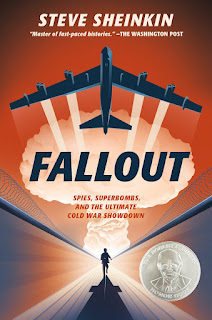
For my newest, Fallout, a Cold War thriller, opening options included an American pilot getting shot down over Russia and a brilliant mathematician at Los Alamos realizing how to build a hydrogen bomb. I settled on what’s probably my favorite opening scene in any of my books: a thirteen-year-old Brooklyn paperboy stumbling into a Soviet spy ring.

It’s a cinematic scene with plenty of documentation. It doesn’t require background knowledge of the Cold War, and it sets up a lot of the stuff I want to talk about in the early chapters. Why are the Soviets and Americans spying on each other? Why are the stakes so high? How can seemingly small details and ordinary people shove the fate of the world in one direction or another?


Give It a Try

Think about a current project. Look over your research notes. Pick some favorite moments from your story, things that might work as a two- or three-page prologue. Go through them one at a time and ask yourself:

1. Is it a grabber? Does it pass the I’m-in-a-middle-school-auditorium test?

2. Do I have, or can I find great sources?

3. Does the scene/story require a lot of background knowledge or explanation in order to make sense? (If so, it’s out.)

4. Does it set the right mood? Meet the “what is this book about?” challenge?


You’ll likely come up with a few candidates as you research. I’d say write them all. You may well end up using all of them, in different parts of the story. But hopefully one will stand out. When it’s right, you’ll know it!


Meet the Author

Steve Sheinkin is the NYT bestselling author of fast-paced, cinematic nonfiction for young readers, including Bomb, Fallout, Undefeated, The Port Chicago 50, Born to Fly, and The Notorious Benedict Arnold. Awards include a Newbery Honor and three National Book Award finalist honors. He lives with his family in Saratoga Springs, NY.

Friday, February 4, 2022

Writing for the Educational Market—A Research Junkie’s Dream

 by Carol Kim


From a pretty young age, I loved doing research projects. I would hunker down in our home “library” surrounded by two sets of Encyclopedia Britannica and an entire series of Time/Life books that covered every science and nature topic imaginable.

Despite my love of exploring facts, I didn’t end up in a profession that involved doing research.

Why? I think it’s because I didn’t want to specialize; I enjoyed exploring and learning about EVERYTHING. But being so unfocused didn’t really lend itself to a profession.

Until I discovered writing for the educational market.

It’s a research junkie’s dream job!

What Is the Educational Market?

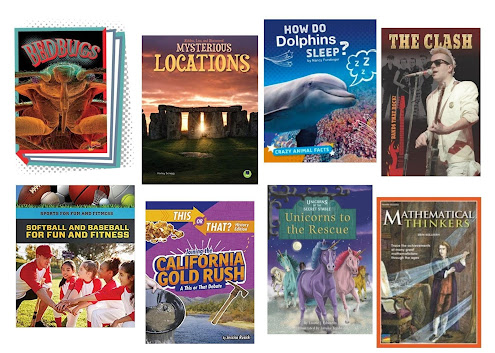
The educational market refers to books written primarily for schools and libraries. These books are often referred to as work-for-hire (WFH) children's books. The publisher determines the subject and then hires writers to create the content according to their specifications.

Most WFH books for the education market are nonfiction. They focus on science, math, and social studies, but can cover a wide range of topics. Details such as word count and reading level are set by the publisher.

Some of the biggest differences between the trade and educational market involve payment and creative freedom. In most cases, writers are paid a flat fee for their work, but no royalties. They receive a byline, but the publisher owns all the rights to the book. All parameters (e.g. topic, word count, reading level, and structure) are set by the publisher.


                                                Get ready to research a wide range of topics!


Tips for Conducting Research for Your WFH Assignment

If writing educational books sounds appealing, then I highly encourage you to explore breaking into this market. And once you do, here are some of my best tips for researching your books.

It’s not necessary to dig deeply into your topic

This is not a dissertation you are writing. It is a children’s book, and many are written for elementary school-aged kids. Most of the books I write are in the 1,500 to 2,000 word range. That does not allow for extensive exploration into your book’s topic. Think about it– if the book is to include four chapters, plus an introduction, that only leaves you around 400 words per chapter.

Keep your audience in mind

Every typical WFH assignment will include specifications about the target reading level of your audience. This means your research should be focused on information that would be both understandable by this age group, and be interesting to them.

Try to find some informational gems

This kind of goes against my earlier advice of trying to avoid going deep down research rabbit holes. But finding and including something about your topic that is not widely known can surprise and delight your reader. Recent sources can be the way to find these treasures.

Avoid the over-researching trap

One mistake I made with my earlier WFH projects was spending hours digging deeply into the topic before creating an outline. I ended up with a lot of unused research.

 It's much better to start with just enough research to create an outline. Wait to go deeper until you start writing. You can better target your research, which is much more efficient and effective. Believe me, it will save you a lot of time. 

If you are a research junkie, WFH can be a great outlet for your love of unearthing facts. While the monetary rewards are somewhat modest, I like to think of this work as getting paid to explore topics you previously knew nothing about. And who knows? Maybe your next book idea will come from some of that research you had to leave out!


Give It a Try

For those of you who want to examine this market further, start by exploring educational books. Visit a range of educational publishers and take a look at their catalogs. Here are a few to get started: Capstone, Lerner, Enslow, North Star Editions, and Amicus. See what kind of books they publish, topics they cover, and grade levels. Try finding some at your library (including ebooks) to take a closer look. If they seem like books you might enjoy writing, then study their WFH submission guidelines.


Meet the Author

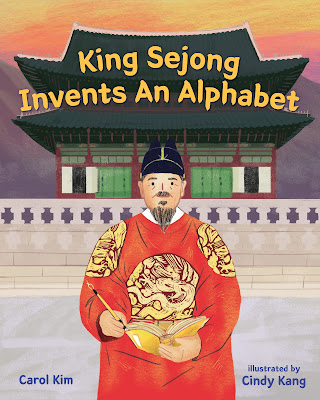
Carol Kim believes books and words have a magical ability to change the world for the better, and she writes for children with the hope of spreading some of that magic. She is the author of the picture book biography, King Sejong Invents an Alphabet as well as dozens of fiction and nonfiction books for the educational market. Carol relishes unearthing real-life stories and little-known facts to share with young readers. Learn more at her website: www.CarolKimBooks.com or her website on the craft and business of writing for kids: www.MakeaLivinginKidlit.com.


Thursday, February 3, 2022

Lights! Camera! Action! Starring: Versatile, Vivacious Verbs

By Beth Anderson


When I write an historical picture book, I see a movie in my head, and the challenge is bringing that movie to the page. Illustrations will partner in the process, but the words I choose need to create scenes, provide action, and invite the reader into the experience of the main character. To accomplish this, verbs take front and center stage. 

LIGHTS come first when you spotlight a character, event, and angle to hook the reader. In this thought process, one vital verb guides me—“take away,” as in, What do I want readers to take away? Then, before I start drafting, I brainstorm words that will support theme, character, topics, and imagery—including a list of verbs. Here are a few examples of "priming the pump” and “filling the bucket."

battle, surrender, resist, fight, give up, unite… [An Inconvenient Alphabet]

sniff, permeate, smell, reek, inhale, investigate, detect… [“Smelly” Kelly and His Super Senses]

Then, it’s time to make the past come alive.

The CAMERA carries the reader through the telling. If you examine the “camera” in a story, most often you’ll see it zooms and pulls back—in and out of scenes, from big picture to character interior. If it’s all close, all distant, or hangs in the middle, you lose potential drama that propels a reader.

When I learned about close/deep third person narration, about “proximity” and “psychic distance,” my writing changed. And the secret was in the verbs. “Head verbs,” or “filter verbs,” add an extra layer that distances the reader—the narrator layer. Words like heard, saw, decided, and other “head” actions serve as filters that dilute the action. To bring the reader INTO the main character’s experience, try eliminating these verbs and directly connecting the reader to the main character—go from reporting to experiencing:

          She heard a crash. vs. BOOM! 

          He wondered where it came from. vs. Where did it come from? 

This intimacy feels a lot like first person narration, but by using close third, you have greater access to the world beyond that one character.

This same concept is also in play when you move from indirect speech to direct speech. (This choice gets tricky with strict nonfiction.)

          He told her to get off… vs. “Get off.”  [Lizzie Demands a Seat!]

Often a story about a person from the past involves a thought process or dilemmas and can be less than exciting on the page. Dig into the interior conflict. Eliminating head verbs enhances point of view, builds character, and “shows” instead of “tells.” Oddly enough, sometimes cutting verbs helps keep a story active.

 ACTION is essential to moving a story forward, engaging young readers, and connecting to history in a meaningful way. Even static elements of a story like “state of being,” context, and setting can benefit from some action.

The first and easiest rule for action is to dump BE verbs whenever possible. AM, IS, ARE, WAS, and WERE are empty verbs. THERE WERE and IT WAS beg for replacements, too. Other “verbs of being” such as SEEM and BECOME often don’t contribute much either.

Franz was a curious child. vs. …Franz’s mind sparked with wonder. [Franz’s Phantasmagorical Machine]        

In nonfiction, providing the context readers need to understand the complexities of a different time and place often results in the dreaded information dump. That necessary context impacts character and is integral to conflict, so we need to interlace those ideas.  

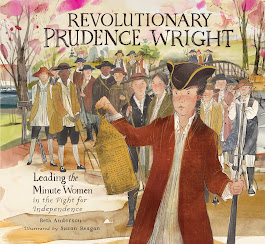
How do circumstances affect their actions? For example, in Revolutionary Prudence Wright, taxes and boycotts must be meaningful without a convoluted explanation.

No British tea! Prudence grew herbs and made her own Liberty Tea.

No British cloth! She spun flax into linen and wove homespun fabric.

NO British sugar! She boiled maple sap into syrup.

No gloves or garments, no ribbons or buttons, no glass or paper! She would do without. Prudence could live with inconvenience and additional work. But she couldn’t live with unjust laws and stolen rights.

Even physical setting can come alive to enhance character, conflict, imagery, and themes. How would your character perceive the location? In Smelly Kelly and His Super Senses, the reader experiences the setting through the character’s super-senses via active, sensory verbs.

The metropolis hummed. Buildings stretched to the sky. Scents familiar and foreign wafted in the breeze.

 Specificity is also golden. Connotation adds depth. The right verb lets you cut adverbs. Or can ring with theme, provide a twist, or add humor.

…unwilling to take liberties with their language. [An Inconvenient Alphabet--American Revolution era]

Finally, we all hear the admonition against passive verbs, where the “actor” is not up front taking responsibility for the action in a sentence, or not mentioned at all. Passives can hide an antagonist and minimize conflict. Reframing amps up the telling.

Tad was frustrated by his lessons. vs. Lessons launched him down the hall and out the door. [Tad Lincoln’s Restless Wriggle]

Verbs are “energizers” that power a story. Of course, like the code for pirates in Pirates of the Caribbean, what I share is more what you call guidelines than actual rules. I confess an upcoming release has WAS in the first and last sentences, and more. It has IT WAS, and some head verbs. But sometimes you need a verb to fade back for something else to come forward. Or need a head verb to make a character present. Or just need the simplest way to state an idea. It’s all about choices to make your movie come alive.


Give it a Try      

Highlight all verbs in a WIP. Do you see patterns? Overused verbs? BE verbs? Where can you cut head verbs to zoom in? Where can you interlace action with context? Where can you add action or more specific verbs? What differences do your new choices make?


About the Author

Beth Anderson, a former English as a Second Language teacher, has always marveled at the power of books. With linguistics and reading degrees, a fascination with language, and a penchant for untold tales, she strives for accidental learning in the midst of a great story. Beth is the award-winning author of TAD LINCOLN’S RESTLESS WRIGGLE, “SMELLY” KELLY AND HIS SUPER SENSES, LIZZIE DEMANDS A SEAT!, and AN INCONVENIENT ALPHABET. She has more historical picture books on the way, including three more stories of revolution, wonder, and possibility in 2022.  


Wednesday, February 2, 2022

Nonfiction Revision Decisions


By Melissa Stewart


First of all, I’d like to thank Pat Miller and the rest of the Nonfiction Chicks—Susan Kralovansky, Peggy Thomas, Nancy Churnin, and Linda Skeers—from the bottom of my heart. What an incredible gift they’ve given the entire children’s nonfiction community!

This year for NF Fest, I’m going to do something a little 
bit different. Instead of writing an essay, I’m sharing
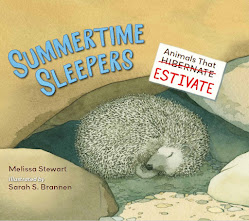
THIS LINK to an interactive visual-audio tool that takes an up-close look at my revision process for Summertime Sleepers: Animals that Estivate.

It includes how my thinking evolved and I worked through big picture revisions as well as a series of drafts where the editor and I are discussing key points via track changes. I created this tool for students, but I think writers will also find it both illuminating and useful. I hope you enjoy it.


Give it a Try
Use the Voice Continuum to come up with a description for the voice of your nonfiction work in progress. Is that the best possible voice for the information you want to share and the way you want to share it? Consider experimenting with a different voice. If you are happy with the voice, how can you revise to make it even stronger?


About the Author

Melissa Stewart has written more than 190 science books for children, including her newest titles Summertime Sleepers: Animals that Estivate, illustrated by Sarah s. Brannen Fourteen Monkeys: A Rain Forest Rhyme, illustrated by Steve Jenkins. She co-wrote 5 Kinds of Nonfiction: Enriching Reading and Writing Instruction with Children’s Books, edited the anthology Nonfiction Writers Dig Deep: 50 Award-winning Authors Share the Secret of Engaging Writing, and maintains the award-winning blog Info-licious Inspiration. Melissa’s highly-regarded website features a rich array of nonfiction writing resources.


Tuesday, February 1, 2022

Finding Your Voice in Writing Nonfiction

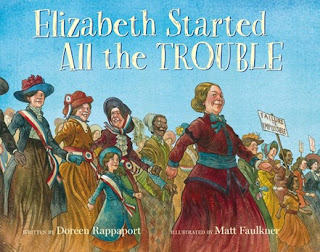
By Doreen Rappaport


Writing nonfiction for kids is an absolutely wonderful career. It’s a passion, a commitment to the young to present important and meaningful stories that will stretch their minds and hearts.

Research is the first step.  The deeper you dig, the richer, more interesting and illuminating will be your work. And your research will lead you to the right approach for telling the story you want to tell. Don’t worry that someone else has written about a subject you’re passionate about. There’s always room for more well-written books on your subject.  Do your research and you will find your unique voice, the hook to tell your stories.

In writing about the African-American struggle from the kidnappings in Africa to the Civil Rights Movement, I read the work of scholars who took years to untangle and present this history accurately. I read poetry, interviews, diaries, biographies, autobiographies, documents.  All these elements confirmed that this was a history of resistance, and that’s when I found my hook--resistance. Primary sources allowed me to accurately recreate historical events without fictionalizing. Having studied and taught music myself, I knew its importance as a cohesive force for Black Americans and had to include this great tradition. And so, my trilogy uses all these elements. 

Twenty-two years ago, I was asked to write a book on Martin Luther King, Jr.  There were already 10 or so books about him, and I initially resisted because there were so many other great Black Americans whom kids didn’t know anything about, and I wasn’t sure I could find a different way to write about Dr. King’s life.  But I dug in. I went to the Schomburg Center for Research in Black Culture an immersed myself in biographies about Dr. King and in his speeches, interviews, letters, autobiographies, and diaries.  I thought about what Dr. King meant to me, about my Mississippi summer working in a Freedom School, and the joyous day at the March on Washington in 1963, and of course about Dr. King’s now famous speech, and it all came together.

My hook to present Dr. King’s life would be to combine a narrative punctuated with words by this great man, and so Martin’s Big Words: The Life of Dr. Martin Luther King, Jr. was born.

Seek out experts to clarify facts. A coal miner helped me with my book on a mining strike in Pennsylvania. I reached out to Justice Ruth Bader Ginsburg, who read and commented on every page in my almost final draft, catching confusion and demanding greater clarification, helping me simplify but not dumb-down legal arguments. I wanted to add Cherokee words and phrases to my book about Wilma Mankiller, and her husband provided them and a pronunciation guide. I have found people more than willing to help me, because they too wanted accuracy about what I was writing.

Never fear criticism.  It will only strengthen your work. Have a few writer friends whom you trust to show your early drafts. Ask them to read your revisions, also. 

Write, rewrite, rewrite, rewrite.  Revision is the key to all writing.

Read nonfiction books by other writers.  When I began, I read all of Jean Fritz’s early books. I don’t write at all like her, but she taught me about “attitude” and point of view, that we all are unique, and there are lots of way to tell a story, and they are all valid if they are grounded in research and careful self-editing.

And remember, there will be stumbling blocks along the way.  Times you think you’ll never get it right. You will.  Walk away from the book for a while. Sometimes, I walk away for a month or so. Right now, I’m working on a book that I put away two years ago.


Give it a Try

I know you have unfinished manuscripts in your files, books you just "couldn't get right."  Well, maybe you couldn't get them "right" when you wrote them a while ago, but dig them out, re-read them, smile about what is strong, think about what doesn't work. You might be surprised that with fresh eyes you can come up with solutions to finish the book. I'm working now on a book that I put away 10 years ago. A long time, right?  Well, I think I've solved most of the problems. Getting away can be so important, and having the courage to go back is essential. Good luck!  Follow your passion! You can do it, too!


About the Author

Doreen Rappaport is an award-winning author of 75 children’s books that celebrate multiculturalism, historical events, the lives of world leaders and the stories of those she calls the “not-yet-celebrated.” Her books have received critical acclaim for her unique ability to combine historical facts with intimate storytelling, and for finding new ways to present the lives of iconic heroes such as Martin Luther King, Jr., Ruth Bader Ginsburg, and the Statue of Liberty. Among her numerous honors, Doreen is the recipient of The Washington Post Children’s Book Guild Award for Lifetime Achievement for the writing of nonfiction. Visit her at www.doreenrappaport.com