When writing picture books, we’re told to leave room for the
illustrator. Pictures tell half the story. But in graphic novels, the visual
story is much more important. A picture is literally worth a thousand words,
and the illustrator’s job is daunting.
If you’re moving to graphic novels from picture books, providing lengthy illustration notes is the opposite of what we’re told to do. Picturing the story takes a mental switch and requires us to build our visual storytelling muscles. To see the possibilities, I recommend studying graphic nonfiction, focusing on “reading” the visual story.
Graphic novels have a lot in common with movies, even sharing some of the same language. (For a great post on camera “shots” in graphic novels, see this post on Rikvah Lafille’s site.) But unlike movies, graphic novels don’t show every second of the action. Otherwise, the books would run to thousands of pages.
Instead, each panel makes a jump in time, and a lot happens between the panels. It’s up to the reader to fill in blanks. The author and illustrator’s job is to figure out what must be shown and what can be left to the reader’s imagination. In other words, what can be summarized, and what must be shown in real time as a scene.
As Jessica Abel and Matt Madden write in Drawing Words & Writing Pictures, every time you start a new panel, you must make three decisions:
- When does the new panel take place?
- Where is it set?
- What does it focus on?
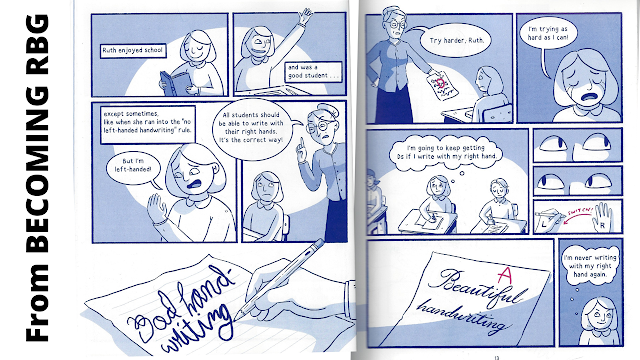
In this spread, a young Ruth Bader Ginsburg learns to dissent for the first time. (For fun, compare this spread to the same scene from I DISSENT, Levy’s picture book biography on the same subject, which was published first.)
The first two panels are summary, a bit of back story about Ruth. In the first panel, Ruth is reading, and we’re told she likes school. In the second, we shift to a completely different scene maybe on a different day, where Ruth is at her desk raising her hand. By including just one illustration per scene, we get little snapshots of Ruth’s life, and the story keeps moving forward, covering big chunks of time.
Now let’s look at the two middle panels on page 12. This dialog
is a snippet of a scene taking place in real time. The jump in time between
panels is very small. What’s changed is the focus of the panels, shifting from
Ruth to her teacher.
Returning to our mentor text, what happens after the dialog?
We get a bigger jump in time, perhaps several minutes, as we move from the
teacher’s instruction to a close-up view of Ruth’s finished assignment. Between
the panels we’ve experienced both a shift in time – from beginning to end of
the scene -- and a shift in focus from the teacher to the assignment. Imagine
how this would read differently if we watched Ruth complete her assignment step
by step. It would slow down the story unnecessarily.
Let’s move to the middle of page 13. This is another scene in real time, but it’s mostly wordless. We are in Ruth’s head, experiencing her thoughts and emotions as she makes the decision to break the rules and write with her left hand. This is pivotal moment in her life. The pacing slows way down, and the jumps in time between the panels is incremental.
First, we see Ruth’s thought, then, a second later, an
extreme close up of her eyes as she ponders. Then another extreme close up of
her eyes, as she continues to think. Finally, she chooses to switch hands, and
we get a close in view of her hands. Using these moment-to-moment transitions slows
the pacing forcing the reader to pay attention.
The more you read and study graphic nonfiction, the more well-versed you’ll become in the conventions of visual storytelling, and the easier writing your own scripts will become.
Give it a Try
Select a spread from a graphic nonfiction book and analyze
the visual story. For each panel, consider: When does the panel take place?
Where is it set? What’s the subject or focus? Also consider how the “camera” is
moving.
About the Author

Find her online at Kirsten-w-larson.com or
on social media @kirstenwlarson.